Monday, November 18, 2013

Got skills? The essential skills for effectiveness and Success

I enjoy the Facebook group "Things they didn't teach us at seminary." Apparently, there's a LOT of things seminaries don't teach, and which, seminarians don't realize they need to learn. Certainly, that's as it must be. No formal educational program can teach everything one needs to know, in whatever field or profession. Still, it begs the question about what it is that "ought" to be taught. Or, what is most necessary to be learned? Where is the balance between theory and practice? Or, this question: What are the fundamental skills needed for effectiveness and success?

Trilling and Fadel, in 21st Century Skills, Learning for life in our times (2009)  cite a study that lists eight essential skills for the 21st century leader (1). They are: 


Oral and written communication
Critical thinking and problem solving
Professionalism and work ethic
Teamwork and collaboration
Working with diverse teams and partners
Applying technology
Leadership and project management
Emotional Intelligence.

Reflecting on my own professional experience, that list seems spot on (and I'm hard pressed to add anything to the list aside from "appreciation for the aesthetic," a quality that can be embedded in several of those skills). My assessment is based not only on reflection on those skills that have made me effective to one degree or another, but also, reflecting on what tends to get leaders "stuck" and ineffective. Upon further reflection I must confess that only two items on the list were learned during my formal educational experience. Even then, I did not achieve a level of passable competence until the post-formal educational experience in "the real world." 

The nature of these skills are multidimensional, multifaceted, integrative, and are acquired and honed over time. In other words, there are maturational and experiential dimensions to these skills which result in capacity, know-how, and competence. For example, it's doubtful one can achieve a high degree of professionalism and work ethic without a corresponding high level of emotional intelligence. With a lack of critical thinking skills, one's ability to do effective project management is limited. And we can write volumes on the outcome that is the integration of leadership, emotional intelligence, teamwork, and working with others. Emotional intelligence rarely comes without some maturation, and, good writers and public speakers emerge after countless hours at the craft--with the just the right balance of successes and failures to yield expertise. One good news is that no one needs to be an expert in any one, or even several, but effective leaders have some level of competence in the cluster. 

The notion that we don't learn everything in school, whether university or seminary, is merely a confession that learning is a lifelong necessity. One of our greatest liabilities is that along the way, despite years of being "students," we never learn how to learn. So, if I were to add one more critical skill needed for effectiveness and success, it would be: being a lifelong learner who has learned how to learn. 

(1) Citing, Conference Board, Partnership for 21st Century Skills, Corporate Voices for Working Families, & Society for Human Resource Management, 2006.

Israel Galindo is Associate Dean, Lifelong Learning at the Columbia Theological Seminary. 

Wednesday, November 6, 2013

Leading Amidst Reactivity

Leadership may be a romantic notion for the naive and inexperienced, but in reality, it's a tough business. Few do it well, fewer still excel at it. In large part, I think this is because, as Edwin Friedman posited, leadership is more a function of emotional process than expertise or competence. Simply put, leadership is about dealing with people, not things. And when you deal with people, you have to deal with emotional process.


Perhaps no other quality is more determinative of an effective leader than the capacity to deal with reactivity in emotional process. Reactivity is a product of anxiety. Leaders who work in chronically anxious systems will be most challenged by this fact, and, I suspect most leaders function in chronically anxious systems. As such, the capacity to lead in the midst of reactivity is one of the keys to effective leadership. Author John Galbraith stated, "All of the great leaders have had one characteristic in common: it was the willingness to confront unequivocally the major anxiety of their people in their time. This, and not much else, is the essence of leadership."

The prerequisite for dealing with reactivity in an anxious system, however, is the capacity of the leader to manage her or his own reactivity in the context of an anxious system. In essence, it is the ability to differentiate oneself as leader amidst the swirl of emotional process, especially in times of reactivity.
Reactivity vs. Sabotage

Leaders can help manage their own anxiety by discerning the difference between reactivity and sabotage. Reactivity is a merely an unthinking, automatic, anxious response to perceived or actual threat. Any time a leader proposes change in a system, you can expect it to be perceived as "threat" at some level, and, it will be accompanied by some level of reactivity. So, the first step in self-regulation for the leader is to just expect it--it's the norm.
Often all that is needed from the leader is to recognize reactivity: "Ah, there it is." What form reactivity takes, and who in the system manifests reactivity through automatic repertoires may be a product of the context and culture of a particular system. Because reactivity is an unthinking automatic response, it's not creative. Reactivity gets "patterned" in systems, to the point one can predict, to some extent, the ways (and sometimes who) a particular system is likely to "react" to threat, perceived or actual. Insofar as one is able to do so, a leader can develop his or her repertoire to respond to reactivity. Since reactivity is unimaginative, it almost does not matter WHAT the leader does, and matters more that the leader responds in non-reactive ways to the reactivity in the system (do not add fuel to the fire).

Helpful Responses to Reactivity:


  • Develop discernment of emotional process. Accept that reactivity is a normal response to threat.
  • Practice perspective-taking. Keep the end in view and accept reactivity as the first step in the process of change.
  • Cultivate self-awareness. Focus as much on your inner emotional process as on the emotional process of the system. Regulate your own anxiety and increase your capacity to make appropriate responses.
  • Develop a repertoire of responses. Your repertoire can span the options of ignoring it to providing a rationale response, but one necessary response is staying connected.


  • Sabotage, in contrast to reactivity, is another thing altogether. It goes beyond being an unthinking response to perceived threat. Sabotage is a willful act which has intent to subvert or undermine. It must be addressed because willfulness introduces toxicity in the system, detracts from the issue at hand, and derails process.

    Helpful Responses to Sabotage.

  • Cultivate persistence of vision. To help the system get to where it's going, you'll need to navigate through all that's in between here and there. Focus on the there.
  • Follow your guiding principles, live up to your standards. "Hold yourself responsible for a higher standard than anybody expects of you. Never excuse yourself," said Henry Ward Beecher.
  • Raise your tolerance level for pain. Remember that when reactivity is directed at the leader, it's not about you, it's about the leader.
  • Remember your leadership function in the system.
  • Be flexible, and if necessary, prepare to be resilient.


  • Leaders need to learn to function in the midst of reactivity. In fact, their capacity to do that well may be the most valuable gift they provide to the systems they lead. Douglas McArthur said, "A true leader has the confidence to stand alone, the courage to make tough decisions, and the compassion to listen to the needs of others. He does not set out to be a leader, but becomes one by the equality of his actions and the integrity of his intent."

    Israel Galindo is Associate Dean for Lifelong Learning at the Columbia Theological Seminary. He is the author of Perspectives on Congregational Leadership, and The Hidden Lives of Congregations. He contributes to the Wabash Center's blog for theological school deans.


    Wednesday, October 16, 2013

    Differentiation of self: family and work

    It’s been a while since I’ve heard from Rick, who always asks interesting “systems questions.” Today he asked: “I was just wondering what steps people can take to not be guided by the emotional programming they have acquired from their family of origin. How does one learn to separate oneself from this programming?”
    That's a tall order, but then, it describes well the work of differentiation, doesn’t it?

    Monday, October 14, 2013

    What sustains excellence in ministry?

    The power of peer-group learning is explored in the book So Much Better: How Thousands of Pastors Help Each Other Thrive." The book presents findings by the Sustaining Pastoral Excellence Peer Learning Project, with contributors from a variety of denominations and educational and church institutions. 

    One key finding is that excellence in ministry is a product of a sustained commitment to lifelong learning. The book identifies the ways peer learning groups promote personal and professional growth. These include the following specific practices (p. 171):

    • Gathering regularly for prayer and worship
    • Examining each other's leadership activities
    • Analyzing congregational contexts
    • Identifying points of needed knowledge or skill
    • Designing or engaging in appropriate learning activities
    • Practicing what is learned in leadership initiatives
    • Evaluating the results for new educational directions.

    • If you are a part of a peer learning group, that checklist can make for a helpful evaluative tool. How many, and how well, does your peer learning group practice the elements on the list? If you are starting a peer learning group the list can be helpful for establishing parameters for a peer learning covenant. 

      Israel Galindo is Associate Dean for Lifelong Learning at the Columbia Theological Seminary. Formerly he was Dean at the Baptist Theological Seminary at Richmond. He contributes to the Wabash Center blog for theological school deans. 

      Saturday, March 16, 2013

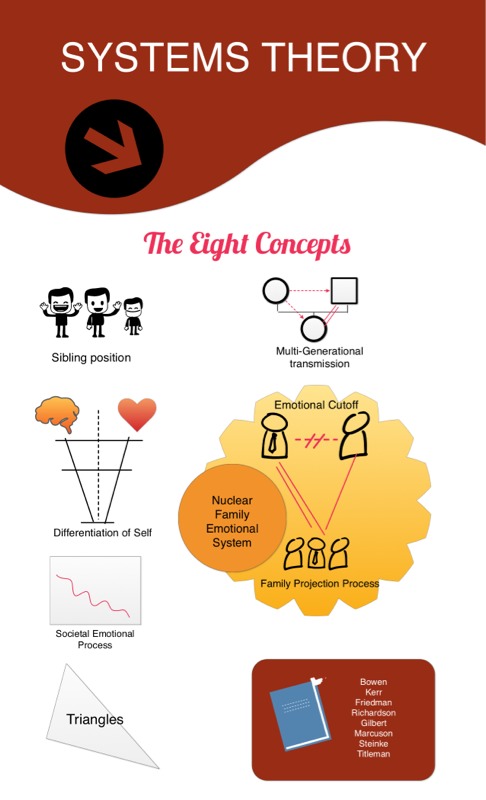
      The Eight Concepts


      Copyright (c) 2013, Israel Galindo

      Wednesday, March 16, 2011

      On BFST Orthodoxy

      A colleague invited some of us on a discussion on the phenomenon of BFST orthodoxy. This is the tendency we've seen among some "Bowenians" to guard the orthodoxy of the theory. At times it manifests itself in:

      * A focus on the correct use of terms, concepts, and vocabulary
      * The creation of a list of verbotem words, phrases, or references
      * A dismissal of certain concepts that are considered "outside" the original theory's schema
      * The identification of "camps" (e.g., Bowen vs. Friedman) and the self-identification with the original conceptualizer with an accompanying dismissal of those not deemed disciples of direct succession.
      * The manifestation of the affects of hubris and exclusivity.

      I think it is acurate to identify these as reactivity. What I most appreciate, and endorse to others, about BFST theory is that it is THEORY. In certain introductory presentations I enumerate the components of what constitutes a "valid theory." I use the list in presentations, and in my introductory systems course to get past latent "resistance" on the part of skeptical and cynical students.

      The list includes the following:

      Theories describe phenomenon as they are perceived (the are descriptive, not prescriptive)
      Theories are grounded in a discipline (in the case of BFST, in clinical psychology)
      Theories are universally applicable to the focus of their concern (in the case of BFST all "relationship systems" regardless of their context)
      Theories are open to being disproved.

      The point being that BFST is a "theory" and not "doctrine" or "ideology."

      When I read or hear "Bowenian Purists" go on about parsing terms or being the self-appointed guardians of orthodoxy by listing what is "verboten" then in my view they have ceased to be theorists and have become ideologists--with the accompanying characteristics of willfulness, exclusivity, and cutoffs. Understand that I think using terms accurately is important, and, it is important to "stay grounded" in the theory and its field (I created a presenation titled "Systems Misunderstandings" to address the issue of the missuse and misunderstanding of basic terms of the theory).

      However, the search for a "pure" Bowenian theory is, I think misguided, and dismisses the richness of Bowen's genius in positing a theory. Theories are not set in stone, and are not meant to be. Theories by their nature develop, grow in their nuance, are open to scrutiny, incorporate new information and adapt to new truths as they are revealed or discovered. Because theories eventually lead to application they are shaped by the contexts in which they are applied, and, by the contributions of the innovators who who carry the theory forward over time.

      Of greater danger is the potential of making a religion out of the theory. This happens when the dynamic of inclusion and exclusion comes into the picture. Religion is about "membership," about determining who is "in" and who is "out"; who belongs and who does not. That tendency creates the necessity of self-appointed or ordained priests to guard belief (orthodoxy) and to make the declarations about who belongs and who does not.

      The pattern is all too, shall we say, "systemic"? The biblical example that comes to mind is those who disciples of Jesus who claimed the priviledge of direct succession--calling themselved Apostles. These gave the Johnnie-come-lately Paul fits. Paul, in his own differentiation of self move had little trouble calling himself an Apostle much to others' consternation. Later on we have the situation of those who, lacking substantive capacity of Self, would identify with "camps": those who claimed to be of Paul and those who claimed to be of Apollos. Move ahead a few years and, predictably, we have the Church Councils gathering to define Orthodoxy, determine who is "in" and who is "out" and to exclude those deemed unworthy of belinging.

      But, this is par for the course in professions and guilds also--one can trace such a dynamic with Freud and his psychoanalysts, for example. Friedman has that great story and getting called on the carpet by the psychoanalytic guild for dariong to put the term "diagnosis" in his brochure. The claim there was that only those who were "in" psychoanalytic guild were previledged, certified, and capable of doing "diagnosis." Friedman's characteristicaly droll response was that the guild should go after Sears' auto service due to their service of diagnosing engine problems.

      Copyright (c) 2011, Israel Galindo

      Wednesday, December 29, 2010

      On children's sermons

      I received an emal from a pastor asking about children's sermons. He just accepted a call to a church at which he'll need to deliver a children's sermon as part of the worship service pastoral duties. I think that's a great thing. And I appreciate his seeking counsel on how to do it well.