Wednesday, July 15, 2015

Ghost hunters and exorcists: The Leader and Secrets

Leaders new to a system often have to contend with the "ghosts" in the system, things that go bump in the night and block progress, defy explanations and create corporate habits and practices that make no sense. Ghosts and their secrets can foster behaviors and attitudes that inhibit openness in communication. There's something going on, but no one's telling. Some systems are more haunted than others, and, there are both benign and malevolent systemic forces at play in any system. But when a leader finds him or herself inhibited by a haunting that impedes progress and health in the system, it may be time to become a ghosthunter and exorcist.

THE LEADER AS GHOST HUNTER

New leaders need to determine how to deal with the ghosts in the system---every system has them. Some leaders set out to be ghost hunters, others try to be exorcists. Those ghost may be a beloved former pastor who has been elevated to sainthood, or the demons of generations past who still haunt the system through legacies.

Dealing with secrets in a system is a challenge, not only because the issue is complex, but also because organizational leaders, especially clergy leaders, are expected to be the official designated secret-keeper in the system. How often does a conversation start with, "I'm telling you this in complete confidence, Pastor . . . ," or "Just between you and me...." Referring to "secrets" in this case we do not mean betraying a confidence, or the indiscriminate release of sensitive, private, or potentially harmful information. In other words, when ghost hunting, it's important to differentiate between secrecy and privacy. Secrets, as a transactive dynamic is a system, tend to be willful, unhealthy, anxiety-driven, and potentially toxic. What is "private" is not necessarily harmful, and indeed, may be healthy. For pastors in a system that uses its leader as confidant to secrets that bind anxiety, it can be helpful to refuse to carry the secret or it's burden, or for the pastor to find a confidant who can help navigate how to handle secrets without being left powerless. In other words, pastors, or any leader, can use the power of the confessional to bind the anxiety of the secret.

The ghosts that leaders content with in a system are secrets that are an intentional concealment of information by one or more persons in the system who are impacted by it. Secrets are used as a form of information control, in which some information is under the control of a person in the system who purposefully hides this information from someone else. In this type of secret the information that is withheld is critical to the one whom the information is concealed from because it has an impact on his or her life or ability to function. It is not uncommon for systems to withhold information from new leaders about sensitive issues, thereby setting up an immediate pattern of secrecy, and, leaving the leader powerless to address the issue.

Often, leaders as ghost hunters must seek out the intergenerational ghost in the system passed on though multigenerational transmission. This can be the lingering influence of a founding pastor, unresolved issues from a crisis with a former staff member, or a secret in the system based on shame or guilt. In a theological school, it may be a "faculty of origin issue." A painful church split can leave a number of lingering ghosts in the system. At a former congregational ministry context it was four years until I discovered, quite by happenstance, that the church had previously dismissed a staff member in my position. No one had ever mentioned that incident, not during the hiring interviews, and, not even in the intervening four years of personnel reviews, staff meetings, committee meetings, or myriad of conversations.

Symptoms and manifestations of ghosts in the system

It takes a lot of energy to feed a ghost and keep a secret, and, it can take a toll on a system and on individuals. Look for a symptom bearer who exhibits the manifestations of secret-keeping: stress, anxiety, depression, and shame. Sometimes one symptom is misplaced distrust and anger toward the leader. Check to see if the blowback on certain questions and issues is disproportionate to questions and feels like a personal attack.  Organizationally, ghosts and secrets in the system create a difficulty in maintaining intimacy in relationships, maintain chronic long standing cut offs, even result psychosomatic symptoms. Characteristically, secrets in the system leave people feeling powerless.

Evan Imber-Black identified four main ways that family secrets may shape and scar us: (1) they can divide family members, permanently estranging them; (2) they can discourage individuals from sharing information with anyone outside the family inhibiting formation of intimate relationships; (3) they can freeze development at crucial points in life, preventing the growth of self and identity; (4) they can lead to painful miscommunication within a family, causing unnecessary guilt and doubt. Since secrets can serve the same function in any relationship system, any leader may find her- or himself dealing with these in an organization as well.

THE LEADER AS EXORCIST

Sometimes it becomes necessary for a leader to play exorcist when ghosts impede progress or health in the system. One way is to uncover the narrative of the secret. Often, it's not the secret that holds a power in the system, it's the narrative built around its origin and subsequent interpretations. Like the parlor game of "telephone," over time, the secret gets corrupt and convoluted to the point that what really happened hardly matters--it's the fact that the secret is maintained and serves a transactive function in the system that matters. In this case the leader-exorcists can simply ask persons to "tell me the story about what happened." Listen for both content and emotional process, though it's the transactive process that will be most telling (do people maintain the secret, protect the ghost, share the "secret" readily, keep the leader in the dark?). One way to get the ghost out of hiding is to compare narratives. Sometimes, playfully challenging the narrative in a non-threatening way can challenge recall, misinterpretation, or dig deeper. The conversation may go like this:

Leader: "That's interesting. Someone told me that the reason was ________."
Staff person: "Well, that's what I heard."
Leader: "Does that ring true to you?"
Staff person: "Well, no, come to think of it. It does sound a bit strange."
Leader: "What do YOU think might have really happened?"

Another way to exorcise ghosts is to reinterpret the narrative around the secret. Leaders enjoy the privilege of having the platform to not only envision the future narrative of an organization, but also to reinterpret its past--including, re-weaving and re-interpreting the narratives around ghosts in the system. It can be as simple as sharing, "You know what I think really happened?" Interviewing the "ghosts," like a former pastor or boss, will yield a different perspective that can be shared as a corrective to a toxic narrative: "Let me share with you how ___ remembers it." Certainly you'll want to ask permission to share in order to not violate a trust.

One powerful, and redemptive, way of exorcising ghosts is to absolve the IP or the scapegoat at the center of old secrets that keep the system stuck. The function of blame fosters irresponsibility, and ghosts and secrets often enable that. Long dead family members can be blamed for the lack of success of individuals in the family, or, of a whole generation! As long as they are kept "alive" as ghosts in the system, people can choose to not take responsibility for their own fate. I know of one pastor who, after some ghost hunting, chose to exorcise a shame-related secret that kept the congregation stuck on issues related to anyone occupying the position of "pastor" in the congregation. This pastor invited a former pastor, who functioned as "ghost" in the narrative of the congregation, to the annual church homecoming one year. Merely naming the pastor's presence and his place in the history of the church served to shift the story and "out" the negative demonizing narrative maintained by some members.

Engage in selective disclosure

I like Peter Rober's concept of selective disclosure as an approach to dealing with secrets is a system. It can help invite others to participate in exorcising the ghosts. "The concept highlights that what we are dealing with is a multifaceted continuing process in time: a process filled with tensions, small decisions, and good intentions. It refers to a process of selection as to whom to tell what, how much to tell, when to tell, and so on," wrote Rober. It takes into account the reality that what is needed is not just more more information, rather, it is attention to emotional process that creates a dialogical space in which questions can be asked and some things can be said, without requiring, or demanding, that everything is revealed.

The concept of selective disclosure takes seriously the potential destructiveness of "outing" secrets while making space and opportunities for a  safe way in which people can deal with sensitive "family" issues. This approach removes the toxic element of willfulness and coercion on the part of the leader and helps create a more open, safe, and honest environment in which to talk about the ghosts in the system. In this way leaders can provide "a dialogical space in which people listen to what is said, accept that not everything can be said, respect that there are good reasons why things cannot be shared, and are open to whatever is said that has not been said before. Such a view based on the concept of selective disclosure invites compassion and empathy and recognizes secretholders as well as those who do not know in their struggle to find stories they can live with" (Pelias, 2008, cited in Rober, et al. (2012)).

All leaders will need to deal with "ghosts" in the system at one time or another. Those that impede the leader's effectiveness and maintain pathological patterns of dysfunction in the form of "secrets" are often the most toxic to a system. Leaders do well to respect the power of secrets in a system, and the potential consequences of unlinking them from the functions they serve in a system. But leaders are also called to foster health and responsibility in the systems they serve. On occasion, leaders may find themselves functioning as ghost hunters and exorcists in order to bring about release and redemption in the system.

Sources

"The emotional burden of secrets. Consequences for somatic health and implications for health care," by Wismeijer AA, Vingerhoets AJ. Journal Tijdschr Psychiatr. 2007;49(6):383-9.

"Family Secrets," Allan N. Schwartz, LCSW, Ph.D. Updated: Apr 25th 2007.

"The Power of Secrets," Evan Imber-Black. Psychology Today 31.4 (Jul/Aug 1998): 50-53+.

"In Search of a Tale They Can Live With: About Loss, Family Secrets, and Selective Disclosure," Peter Rober, et al. Journal of Marital and Family Therapy38.3 (Jul 2012): 529-41.

Israel Galindo is Associate Dean for Lifelong Learning at the Columbia Theological Seminary. Formerly, he was Dean at the Baptist Theological Seminary at Richmond. He is the author of the bestseller, The Hidden Lives of Congregations (Alban), Perspectives on Congregational Ministry (Educational Consultants), and A Family Genogram Workbook (Educational Consultants), with Elaine Boomer and Don Reagan. Galindo contributes to the Wabash Center's blog for theological school deans.


Wednesday, April 22, 2015

Triangles in the emotional field

Students of Bowen Family Systems Theory (BFST) learn early about the importance of triangles in relationship systems. The concept of the emotional triangle is one of the original eight basic concepts in BFST. So foundational to the theory of emotional process is the concept of emotional triangles that it is often said, “If you understand triangles, you understand the theory.”

Thursday, February 19, 2015

Your Mother Was Right: Life's Not Fair (and sometimes, you shouldn't be)

Most of us carry a little tape in our heads of things our mothers said repeatedly. And sometimes we repeat those things, often unintentionally mimicking mom’s voice. One of those things your mother probably said, especially if you had siblings, or, when little friends came over to play was, “Play fair!” But you likely remember what your mother also said on those occasions you protested “It’s not fair!” She likely quipped, as countless mothers have through the ages, “Life’s not fair.” (And, if your mother was like mine, she may have added, “Get over it.”).

One source of anxiety for many leaders is the need to be, or at least appear to be, “fair.” Adult employees or staff persons, like children, will cry “foul” when they feel they are treated unfairly. And reactive employees, or church members, will be quick to charge pastoral leaders with being unfair as a quick way to get a hearing or gain an advantage. The trap for any leader comes when he or she feels the need to live up to the expectation that it is the leaders’ job to always be fair, and to live up to what that means for everybody in the system. 

But the fact is, as your mother said, life is not fair. And, not everything is equitable or needs to be. What seems fair for one person or group in the system will seem unfair to another. And while I always say “Never question people’s motives,” I am also fond of reminding myself, “Never underestimate the power of the baser motivations.” On any given day, anxious persons will always choose what is best for them over what is best for the system. 

Recently a pastor shared his experience during a church business meeting in which a troubling and willful church member took the floor during a time of debate. As is typical during times of congregational crises, attendance during this particular business meeting was robust. Acting as moderator the pastor sought to keep things orderly and announced that each person would be allowed to speak three minutes for or against the issue under debate. The troubling member was the first to stand to have his say, but strongly protested that three minutes was not enough time to speak his case.

Not wishing to seem unfair, and thereby antagonizing the troubling member and his supporters, the pastor said that he would stick to the three minute rule, but would allow others to “give” the speaker their three minutes. Whereupon, starting with the man’s daughter, several people “gave” the man their three minutes, enabling him to go on to monopolize the business meeting for about fifteen minutes! 

In a moment full of anxiety, trying to appear “fair” (and likely with all good intentions about acting fairly) this leader effectively not only empowered the most willful person in the room, but also failed to challenge people to take personal responsibility for their thoughts and beliefs. The tactic failed to challenge persons to take a self-defining stance for their positions, viewpoints, or beliefs. Instead, this leader facilitated a “herding” mentality. Instead of each individual standing up and taking responsibility for him- or herself, many chose to allow another to speak for them. 

Leadership requires courage, and acting courageously in the midst of crisis is hard. But leaders need to remember that they are first responsible for the welfare and health of the system as a whole, and their own functioning in their leader position. Everything else is secondary: other people’s functioning, other people’s happiness, or, whether every decision is “fair” for every individual or group in the system. 

Thursday, January 15, 2015

Do you want to be great?

I have come to appreciate the cycle of blockbuster best-selling leadership-in-organization books. To be honest about it, they’re good for business. It isn’t too long after one of these best-sellers hits the bookstores that I get an uptick in consultation requests. I used to get calls asking for help in getting organizational staff leaders to develop “habits” for being effective leaders. Then, the calls were about helping organizations and schools become “learning organizations.” 

Tuesday, July 29, 2014

The Five People You Need as a Leader

Leadership is lonely, the say. That is true to a real extent. Few understand the weight of responsibility that comes with leadership, or the shifts in relationship that can bring isolation and distance. But to say leadership is a lonely position does not mean one can do it alone. Even the most differentiated leaders need to be meaningfully connected to others in the work system, and, to a personal support system. Ask most leaders for the secret of their success and they'll likely tell you two things: "I surround myself with the best people," and "I have invested in a long-term peer support system."

When one is in a position of leadership one's network of relationships both expands and narrows. You'll be connected to a wider number and variety of people in the organization to some extent and in several capacities. At the same time you'll narrow the scope of your direct charges, your "inner circle" of second-chair leaders and associate staff. In other words, you need to be present to all but accessible to only a few. In the mix of those networks there are five people every leader needs to help her or him be more effective. 

You may discover these five people within your organization as work colleagues. Others may exist outside of the job environment. Regardless, they each will contribute something important to your success as a leader. 

1. The Encourager. Whether friend, second chair, spouse, deacon, or Mom, this is the person in your life, sometimes the ONE person, who says "You can do this." And because he or she genuinely believes it, you'll believe it too.  This may also be the person that helps you give yourself permission for taking a day off, or allowing yourself a "mental health day." Sometimes, this is merely the person who, regardless of circumstance, just likes you, no matter what. 

2. The Antagonist. While irksome, every leader needs an antagonist. Iron sharpens iron, and leaders may grow dull without the challenge antagonists provide. Antagonistic people may be reactive, but they are not necessarily unintelligent. If you can listen to their arguments and perspectives past the grating annoyance, they can provide correctives to your blind spots. Believe it or not, antagonists can be a resource to a leader, as long as they don't tip over into sabotage. 

3. The Skeptic. Most leaders are, by necessity and character, optimists. They likely would not have taken the job if they didn't believe in possibilities, potential, and ultimate positive outcomes. This is what helps leadership "sell" the vision that gathers others around a shared value and the tasks that make things happen. But an overly-optimistic leader with Pollyanna rose-tinted glasses does not serve an organization well. Skeptics can help you curb your enthusiasm in those times when operating out of realism is a necessity. You don't have to buy into a skeptic's perspective, but he or she can provide a balance to our tendencies for wishful thinking, self-referencing, and denial. 

4. The Lieutenant. God bless this type! Most leaders would be lost without them, and most organizations would fail to make progress without their energy, skills, and single-minded drive. The Lieutenant in the organization is the one who delivers on the dreams. She's the one who makes it happen. He or she is your "Number One." Give them a vision and they'll find the ways to make it a reality. Most of the time, the best thing a leader can do is get out of their way and let them do what needs to be done in the way THEY think best. 

5. The Sage. The best leaders tend to be smart, but none are omniscient. In fact, those who seek to be ("know-it-alls") very quickly cease to be effective as leaders. In leadership, a little bit of humility goes a long way. Yes, your staff and your constituents want, perhaps need, to believe you are smart and know what you are doing. But, the reality is that the challenges of leadership are more about knowing how to function than knowing answers. Effective leaders know there's a difference between expertise and wisdom. This is the value of the mentor, consultant, or advisor in the life of a leader. The Sage helps the leader with three critical practices: perspective, discernment, and self-understanding. 

Do you have these five people in your life? Where are they in your support networks--at the job or outside of work? Which do you need to cultivate to complete this company of the five people you need as a leader?

Israel Galindo is Associate Dean for Lifelong Learning at the Columbia Theological Seminary. Formerly, he was Dean at the Baptist Theological Seminary at Richmond. He is the author of the bestseller, The Hidden Lives of Congregations (Alban), Perspectives on Congregational Ministry (Educational Consultants), and A Family Genogram Workbook (Educational Consultants), with Elaine Boomer and Don Reagan. Galindo contributes to the Wabash Center's blog for theological school deans.

Monday, July 21, 2014

Six "Tells" of the Differentiated Leader

I had an interesting conversation with a doctoral student during a recent trip. He was at the proposal writing stage of his study but struggling with putting his thoughts together. He said he wanted to "study something about differentiation of self and pastoral leadership." I said it sounded like he was at "the fuzzy stage of research," that point where we have a notion about what we want to write about, but not really sure what, exactly.

"Yes!" he said, "that's exactly where I'm at!"

 We talked some more about his ideas. I found it an enriching conversation, and it sparked in me some thinking on the issue. Recently, someone else had asked me "How can leaders know if they are functioning in differentiated ways?" That's a great question given (1) the limitations of our own subjectivity; (2) our propensity for self-referencing; and (3) the challenge of Bowen Family Systems Theory to "stick to observable facts" when interpreting emotional process.

One common error is the misunderstanding of striving to "be a self-differentiated leader." That is, achieving some mythic state of being. Leaders will do better to focus on what Murray Bowen called the "functional level of differentiation." I think that means that the "tell" of a differentiated leader is more about one's capacity to function in context and relationships and less about an over-focus on some internal state of being arrived at through gnosis, expertise, or practices.

Here are six ways to"tell" one is functioning as a differentiated leader: 

  1. Assess your pattern of functioning over time. Is there evidence of consistent self-regulation and effective functioning over a span of periods of high-anxiety, crises, stress, and times of relative calm? 
  2. Assess your repertoire for responding to rather than reacting against anxious behaviors and situations. Do have have a wider range of responsive options than you did previously? Can you both act differently and think divergently? 
  3. Assess to what extent and in what ways your functioning directly influences toward the better the functioning of people most closest to you. 
  4. Assess your capacity to consistently take a more principled position and hold it against the opposition of important persons in the system. Do you function consistently out of your values than out of what is expedient? 
  5. Assess the extent to which your functioning is increasingly mature and non-reactive in the face of stressors that used to trigger reactivity and poorer functioning. 
  6. Assess the extent to which other people close to your leadership position exhibit higher levels of functioning and less reactivity (fewer cutoffs, less enmeshment, less seriousness, reduced gossip, less secrecy, etc.). 

My new doctoral student friend thanked me for our conversation. He reported being encouraged and having some new ideas after our talk. I think he'll do well with what sounds like an interesting research project. I look forward to his research. I hope he'll discover additional evidences of a differentiated leader. I think we can always use a few more.

 Israel Galindo is Associate Dean for Lifelong Learning at the Columbia Theological Seminary. Formerly, he was Dean at the Baptist Theological Seminary at Richmond. He is the author of the bestseller, The Hidden Lives of Congregations (Alban), Perspectives on Congregational Ministry (Educational Consultants), and A Family Genogram Workbook (Educational Consultants), with Elaine Boomer and Don Reagan. Galindo contributes to the Wabash Center's blog for theological school deans.
Friday, June 20, 2014

Marcuson's 111 Tips to Survive Music Ministry

I've worked with several church musicians over the years, in various ministry contexts. I've been fortunate that most of those working relationships have been positive, collegial, and enriching. I'm doubly grateful in that some of my most interesting coaching sessions with pastors and staff often involve issues with "the music person" at the church. Church musicians tend to be a creative and artistic lot. Often it seems the biggest challenge with working with church musicians is that they are, well, creative and artistic. But, truth be told, church musicians have it just as challenging working with overly-cerebral, left-brained, tone deaf colleagues.

Second to the congregational youth staff person, church musicians may be the most prone to be the focus of anxieties stemming from everything from tastes in styles, performance issues, aesthetic predilections, or systemic scapegoating.

Margaret Marcuson's new resource, 111 Tips to Survive Music Ministry, is a great help to those working in music ministry. The tips are "right on": common sense, intuitive, and practical. The tips are organized by categories: worship, relating to the pastor, music, leadership, learning, pastoral care, and five more.

The ebook is available from Creator for the special limited time introductory price of just $2.99. You can purchase it here.

Israel Galindo is Associate Dean for Lifelong Learning at the Columbia Theological Seminary. Formerly, he was Dean at the Baptist Theological Seminary at Richmond. He is the author of the bestseller, The Hidden Lives of Congregations (Alban), Perspectives on Congregational Ministry (Educational Consultants), and A Family Genogram Workbook (Educational Consultants), with Elaine Boomer and Don Reagan. Galindo contributes to the Wabash Center's blog for theological school deans.

Monday, June 9, 2014

Money and What it Represents Part 2: Approaching Stewardship Education As A Spiritual Issue

I am preparing for an online course on money and ministry to be taught in the fall with author Margaret Marcuson. Money, and what it represents is a complex issue in congregations. As an educator I'm interested in how people acquire what they learn, including perspectives, values, and habits. We know that certain things need to be learned in particular ways. As such I'm intrigued how often we teach things the wrong way, or, simply teach the wrong things. On the topic of money and stewardship, this seems to be especially true.

Stewardship is about a Christian’s personal, volitional response to God's call to discipleship as part of the Body of Christ. As such, stewardship is primarily a value (an individual, but also a corporate one), a practice (behavior) only secondly, and a concept or belief, thirdly. Given that framework, most congregations seem to tend to “teach” it backward and incompletely. Too often we attempt to teach Christian stewardship by using the teaching-by-telling approach and leaving it at that, never touching on the affective and the volitional and failing to facilitate the practice. Then, we naively expect that change will happen in the life of our members related to stewardship.

Stewardship is a Spiritual Issue

Stewardship is a spiritual issue, and it must be addressed like every other spiritual issue in the life of the believer. The issue is not to TELL people that they need to give 10% of their money to the church, rather, it is to help people arrive at a conviction of value by engaging them in the dialogue of theological reflection by asking, "Share with me, how are you responding to God in your stewardship of life?"

Our failure to help our members learn—--really learn-—-stewardship has had tragic results. Our unfortunate approach to teaching stewardship in the lives of our members means that we’ve done a great disservice to them over the years by being ineffective about helping them address the stewardship dimension of discipleship (except when it's time to ask for money for the church budget we tend to not even talk about it. And all evidence is that we’ve failed even there, since most members give only 2.3% of their income to the church).3 I suspect that we, the church leaders—pastors, teachers, deacons—have been irresponsible in helping our members in this, probably because we ourselves have not dealt with our own issues related to money.

In most of our churches, a significant number of our members are under the oppressive burden of debt, so much so that they are unable to respond in responsible stewardship to God. I suspect they resent us for it, because we've been of no help whatsoever to them in dealing with financial stewardship while making them feel guilty about not giving more money to the church. We've not been prophetic about challenging the values of the world our members have embraced and the myths of materialism the world teaches. So when we once or twice a year make our pitch for money, they can’t hear it, at least, they don't hear it theologically. And then there are the church members who have bought into the values of the world's materialism: how many people in your congregation spend more on feeding and caring for their pets than they do giving to the hunger offerings at church? How many spend more monthly on their cable TV and Internet service bill than they do to missions? How many church members spend more money on their annual vacation than they do giving money to help the homeless?

It's About Values

The issue of stewardship is complex because it less about the money and more about values. I think that we ought to address the issue of stewardship in the same way we address issues about faith development and discipleship: by taking into account developmental life stages and cycles. Different epochs in life require different messages about one’s response about stewardship of life. As a specific example: mid-life calls for a stewardship of generativity (learning to face the limitation of means and beginning to invest in the next generation. In effect, learning how to give your life away.). But that is not the case for adolescents and young adults whose life stage work appropriately includes acquiring and building. And how unfair, and nonsensical to its audience, are messages about stewardship of money to young children—who have no money and no cognitive concept of percentages or of proportional giving? And end-of-life stages, and stages of senescence, call for different ethical and theological decisions about stewardship. Only through dialogical engagement can people deal with these issues authentically in their lives. I suspect we make our messages of stewardship ineffective when we assume that it is the same for everyone at the same time, and we attempt to teach everyone the same way.

In terms of educational programming, not everything is for everybody at the same time. I think we confuse and make people feel uselessly guilty when we send the message that, regardless of their life stage, their family life cycle stage, and their particular life situation, they are supposed to function and respond like "everyone else." But rarely are they given the opportunity for learning through dialogue that leads to application, and therefore, I suspect most choose to make no legitimate response at all to God’s call in this area of their lives. Stewardship is as much a value and a choice as it is a concept and a practice. Unless we address all four domains of learning--knowledge, affect, behavior, and volition---our members will never “learn” stewardship.

Adapted from: How to Be the Best Christian Study Group Leader, by Israel Galindo (Judson Press)

To learn more about the course Money and Your Ministry, check out the Center for Lifelong Learning. Join us!

Israel Galindo is Associate Dean for Lifelong Learning at the Columbia Theological Seminary. Formerly, he was Dean at the Baptist Theological Seminary at Richmond. He is the author of the bestseller, The Hidden Lives of Congregations (Alban), Perspectives on Congregational Ministry (Educational Consultants), and A Family Genogram Workbook (Educational Consultants), with Elaine Boomer and Don Reagan. Galindo contributes to the Wabash Center's blog for theological school deans.

Wednesday, May 21, 2014

Money and What it Represents. Part 1

I am preparing for an online course on money and ministry to be taught in the fall with author Margaret Marcuson. Money, and what it represents is a complex issue in congregations. The course will examine money and ministry from a systems theory frame of reference. From that orientation, some systems concepts that can help in understanding what's going on are:

  • Money represents something to people. Usually, it's emotional.
  • Money often serves a function. Giving money represents a function of emotions, drives, or values.
  • Since money is a complex emotional issue, it's helpful to never question motives, but observe function
  • Stewardship is a spiritual-emotional issue and needs to be approached and understood as such.

Some time ago a colleague in ministry called to share good news, and, a concern. He was new to the church, only eight months into his new ministry. A relatively new member to the church (she had joined two years prior) had expressed how much she appreciated his ministry and the excitement he was bringing to the church. She gave him an envelope with a check in the amount of $5,000.00, "to be used any way you want for your ministry." My colleague was elated with the affirmation and the gift, but he felt a bit stuck, also. He was seeking counsel about why he felt conflicted about the gift.

When a new (recent) member to a congregation gives a $5,000.00 gift, red flags go up for me. I won't question motive, but I tend to ask questions about emotional functioning. A very FEW people can give large sums of money to a church with no emotional strings attached--but most people cannot, in my experience. Since a congregation is an emotional system--and since small congregations mimic "family" emotional systems--it is naive to think that money (and what it represents by way of its function) does not matter in terms of the impact on the function of the system.

In the case of a large donation from a new member, we may ask, for example:

  • Is this person overfunctioning for the congregation?
  • Is this person dealing with some issues in his or her life that has promted the gift? Why now?
  • Does this person's (immediate) family know he or she is giving this gift? What is this persons relationship with the church? With the pastor?
  • Did the pastor or staff get the gift or was it given to "the church" through usual giving channels?
  • How does the giving of the major gift relate to patterns in the donor's life? In the church? In the pastor's family of origin?
  • Are there guidelines in place (rules or policies) about "major gifts"? Were they followed?
  • Does this action put you in a triangulated relationship?
  • Were there "strings" attached to the gift? Overt or implied? Expectations? Subtle messages?
  • Is the gift a "designated gift" for a ministry, staff person, pet program, pet issue that by-passes the regular budget? Is this gift given in stead or in lieu of regular offering and pledge giving?
  • What are the systemic consequences to the congregation beyond convenience and financial relief?
  • Given the donor's life circumstance, is this a "responsible" act? Is it appropriate?
  • Given the pattern of giving and practice of stewardship of the congregation as a whole, is receiving the gift a responsible act? Is it appropriate?
  • Will accepting this gift change or shift the relationship with the donor?

Events like my friend's experience are great opportunities to do some stewardship education with the church leadership. At least for pastoral leaders who are willing to put the issues on the table and challenge the church about its responsible response to congregational stewardship. Most pastors seem to avoid dealing with it and then wonder why their congregational members are poor stewards. Go figure.

NEXT: Money and What it Represents: Stewardship Education As A Spiritual Issue

Israel Galindo is Associate Dean for Lifelong Learning at the Columbia Theological Seminary. Formerly, he was Dean at the Baptist Theological Seminary at Richmond. He is the author of the bestseller, The Hidden Lives of Congregations (Alban), Perspectives on Congregational Ministry (Educational Consultants), and A Family Genogram Workbook (Educational Consultants), with Elaine Boomer and Don Reagan. Galindo contributes to the Wabash Center's blog for theological school deans.

Wednesday, May 7, 2014

Hacks and Professionals: Which are you?

In his book, A Failure of Nerve, Edwin Friedman wrote about the tendency of ineffective leaders that exhibit the tendency to seek the “quick fix” and who obsess over methods, techniques, and successful programs. This, in contrast to effective leaders who can engage in the hard work of leadership that focuses on bringing the kind of challenge to a system which leads to growth. He said, "The difference between a professional and a hack is not in their degree or training. Both may do what they do with polish; but the hack is not transformed by his experience." (A Failure of Nerve, p. 88).

I think that’s a challenging word to congregational leaders. It speaks to the dependency of so many leaders on fads and packaged programs that provide the promise of the quick fix for quelling the anxious voices who want to be entertained rather than challenged, who want to have “the answer” that satisfies rather than struggle with the questions that challenge, and, who cater to the whining voices of those who cannot tolerate being "bored" by engaging in the very practices and disciplines that lead to growth through the engagement of mind and affections.

The biggest liability for any system whose leader provides the quick fix is that it removes responsibility, denies accountability, and caters to the most anxious and dependent in the system. In the end these actions are inimical to the very processes and experiences that foster growth. In such a system there will never be growth and development toward maturity.

Being Transformed by Our Experience

For ministers and congregational leaders, a disciplined and sustained engagement in the practices of reflection-in-action and reflection-on-practice is what makes a difference in moving from novice to wisdom (or in Friedman's terms, from hack to professional). They guard leaders from being perpetually" blown here and there by every wind of teaching" and becoming distracted from the seemingly unrelated series of experiences day in and week out. Mature leaders are transformed by their experiences as a product of intentional reflection for meaning-making. They are lifelong learners who are inner directed, agents of their own learning, and who know that meaningful learning is more about the cultivation of insight than it is the acquisition of other people's knowledge.

Friedman’s words certainly challenge the congregational leader's own lack of personal and professional growth. I often tell search committees to value personal maturity over “experience.” Some people have years of “experience” but seem to have learned little from it.

Similarly, I witness too many resident congregational educators who seem to spend their careers running a Sunday School or other programs as the end-all and be-all to what constitutes Christian education. Too many seem to not have been transformed by the very discipline they are engaged in: education. For example, too few congregational educators seem able to articulate a well-defined philosophy of education that informs the basic educational questions:

Friday, April 25, 2014

Do You Make these 7 Leadership Mistakes When Dealing with Conflict?

Victor (not his real name) is a local church pastor who sought me out for a consultation. By the time we managed to work out a time to meet he'd been in conflict with some congregational members for eight months. He had been in his mid-sized congregation for three and a half years and thought everything was going well. That is, until he began confronting personal attacks, hearing about "secret" meetings, and noticing changes in some of his church leaders' behavior toward him.

After struggling for eight months and not getting anywhere, Victor starting seeking help in understanding what was going on and what to do about it. To his credit, Victor was also seeking to understand his own functioning in the midst of conflict. He started to recognize long-seated patterns in how he responded to the difficult experience at his church. It did not take long for Victor to name seven mistakes he was making in how he was dealing with conflict. Victor actually wrote down the list of the seven mistakes he was making and worked hard at consciously changing the way he was behaving.

Monday, April 7, 2014

Why are all systems so alike?

During the past three months I've run the gamut in types of organizations during consultations--congregations, non-profits, theological schools, a small business. My experience reminded me of those conversations about how universal the Dilbert cartoons are in hitting the mark regardless of where people work—-from a large corporate firm to a small business, from a for-profit conglomerate to a non-profit. It begs the question, “Why are all systems so similar?”

We hear hints about this apparent truth here and there. “Business is business, whether you’re manufacturing cogs, selling widgets, or selling a service.” I’ve been in certain leadership training seminars where the room held representatives from all manner of contexts, with corporate CEOs to clergy attending to the same latest ideas about how to lead better and manage more effectively in their organizations.

I have some hunches as to why all systems are so similar:

Relationships systems follow universal rules. I first stumbled across this insight when I picked up a book titled How to Run Any Organization. I still have in on my bookshelf, and I must admit it has served me well in all the contexts I’ve worked in: school administration, corporate, congregation, non-profits, etc. The second place where that idea finds support is in Bowen Systems Theory, which identified universal rules applicable to all relationship systems, from family to business; from government to church. Because relationship systems self-organize according to universal principles, we can expect to see certain characteristics that are shared universally. These include: the function of leadership, the presence of anxiety and the manifestation of reactivity, the emergence of homeostatic dynamics, the presence of reciprocal dynamics (overfunctioning-underfunctioning, seperateness-togetherness, etc.), the emergence of systemic patterns that serve a variety of purposes.

Systems of a kind will tend to share the same organizational metrics as indicators of effectiveness, vitality, and viability. The metrics for "educational effectiveness" published by educational institutions--whether universities or theological schools--are similar, if not identical. The metrics used by non-profit organizations (e.g., those related to social value, market potential, and sustainability) apply to organizations of that kind regardless of size, mission, or location. While that makes common sense, what is surprising is how many leaders and board members of those organizations would not be able to identify those metrics if asked.

Complexity emerges from simple rules. While systems and organizations may appear different on the surface they seem all to arise and operation on fundamentally simple rules. The most complex corporation started small and is effective to the extent it can “follow the rules” of its nature. Large congregations look different from small congregations, but ask any pastor and he or she will likely confirm that no matter the size of the congregation, leaders tend to deal with the same problems. A large theological school looks different from a small seminary, but a room full of deans from schools across the spectrum of denominations, geographical areas, and school size will all share about the same challenges. And, they'll immediately chuckle at the comment, "We all have the same Faculty."

Human nature is the same everywhere. Culture, race, ethnicity, and epochs mediate the universal principles that direct relationship systems, but it doesn’t take much to scratch below the surface and discover that human nature is the same everywhere, and it has been for a long while. Perhaps the best place to see this is in narrative-—those stories that are so good about depicting the human spirit and its interior world. Reading the works of the Greek poets and playwrights to Shakespeare, to Checkoff and Dostoevsky to Mark Twain will serve to confirm that we humans laugh, cry, yearn, fear, and hope for the same things—-and always have. Idealists who want to create utopias and social organizations that are “totally new” often forget that those new creations will always be populated by the same old people.

The brain is the same everywhere. There may be a biological cause as to why all systems seem so similar. The organic brain, its patterns and its epistemology, are universally the same for everyone everywhere in whatever culture. Hence the educational truism, “Everybody everywhere learns the same way.” For example, barring neurological anomalies or organic brain syndromes, every person’s brain learns language the same way. And, dismissing claims of clairvoyance and ESP, everybody’s brain processes phenomenon the same way, for the most part. Given that fact, we can expect that when a group of individuals gathers together to form Group A, they’re pretty much going to be more similar than different to the group of individuals that gather together for form Group B. That’s a great convenience to teachers who find they can effectively re-cycle a well-designed courses year after year with little change and still achieve desired learning outcomes with little variance from the norm. This insight can help ease the transition for leaders moving from one context to another is a system of a kind (from one congregation to another, from one theological school to another). Culture and context will mediate some things--like emotional process, practices, ethos, and values--but all systems of a kind tend to function in much the same ways.

What are some of your hunches as to why systems are so similar?

Israel Galindo is Associate Dean for Lifelong Learning at the Columbia Theological Seminary. Formerly, he was Dean at the Baptist Theological Seminary at Richmond. He is the author of the bestseller, The Hidden Lives of Congregations (Alban), Perspectives on Congregational Ministry (Educational Consultants), and A Family Genogram Workbook (Educational Consultants), with Elaine Boomer and Don Reagan. Galindo contributes to the Wabash Center's blog for theological school deans.

Thursday, March 27, 2014

Five Essential Functions of Effective Leaders

Effective leaders, in any organization, are those who can provide the leadership functions their systems need of them. This concept puts on its head any personality-based notion of leadership (charisma, intelligence, gender, race, ethnicity, pedigree, beliefs, looks, confidence, etc.). In other words, leadership is a function of the system, not a product of personality. The counter-intuitive reality is that healthy organizations have strong leaders—conversely, it is not always the case that strong leaders have healthy, or effective, organizations. The question then, is, “What function will I need to provide to be an effective educational leader?”

Reviewing the literature on leadership yields five essential functions of leaders. These five essential functions have appeared in different forms over the years, but they consistently comprise the "top five" on lists about what effective leaders do. They are:

1. Having a vision and communicating it well
2. Articulating goals and identifying strategies
3. Creating an adaptive culture open to change
4. Monitoring progress
5. Providing necessary interventions.

All leaders need to provide those essential functions--whether in a congregation, school, non-profit organization, or business. However, there’s no one best way to provide them. WHAT a leader needs to provide is clear; HOW a particular leader chooses to go about it is a product of both context and personality.

The challenge of the complex nature of the job of leaders, with the multi-faceted dimensions and demands of an organization, calls for an astonishing wide-ranging skills set: from interpersonal relational skills to high-level analytical and intuitive-interpretive skills. Organizational leaders, in whatever role, need to cultivate and apply a wide repertoire of cognitive styles in order to carry out the job, sometimes, in the course of a single day! They need often to switch from abstract, symbolic perspectives to a concrete, realistic perspective from one moment to the next. They may start the day with internal vision-casting in a Zen-like state while driving to the office, only to be engulfed in managerial problem-solving within twenty minutes of sitting at the desk, then, end the day dealing with interpersonal conflicts in the midst of emotional reactivity.

Effective educational leaders do well to remember that in the midst of the urgency and the press of the daily triage, there are only five functions that will ultimately determine their effectiveness. Five things make the difference, for they are the essential functions that the system needs of its leader. It is not much of an overstatement to say that, at the end of the day, all else is distraction. In fact, what dysfunctional systems are very good at is distracting its leader from focusing on and providing the essential functions!

  • To what extent are you providing the five essential educational functions of a dean?

  • What things distract you from investing time, thought, and effort on the five essential functions?

  • Are you stronger in providing one function over others? Which functions do you need to work on increasing your competence?

  • Dysfunctional systems are adept at sabotaging a leader’s focus on the five functions. Are you able to identify ways your system and context inhibits your effectiveness in one or more of the five essential functions?

  • Israel Galindo is Associate Dean for Lifelong Learning at the Columbia Theological Seminary. Formerly, he was Dean at the Baptist Theological Seminary at Richmond. He is the author of the bestseller, The Hidden Lives of Congregations (Alban), Perspectives on Congregational Ministry (Educational Consultants), and A Family Genogram Workbook (Educational Consultants), with Elaine Boomer and Don Reagan. Galindo contributes to the Wabash Center's blog for theological school deans.

    Monday, March 17, 2014

    Truisms worth remembering during times of acute anxiety

    All systems experience episodes of acute anxiety but systems manifest it differently. Relatively stable, resilient and high-functioning systems seem able to respond to episodes of acute anxiety. In contrast chronically anxious systems which lack resilience will tend to be reactive in the face of acute anxiety. That is, they have little tolerance for challenges, lack capacity for self-regulation or for imaginative responses to handle times of acute anxiety.

    Chronically anxious systems share the following characteristics:
    (1) They make someone in the system responsible for someone else's functioning
    (2) They are structured to inhibit the effectiveness of its leaders
    (3) They develop reactive, rigid, and predictable patterns for dealing with anxiety
    (4) They tend to spawn anxiety triangles. 

    While it is more helpful to assess the emotional process at work at the systemic level it can be helpful to observe how symptomology is being played out in the individuals in the system. When facing reactivity at the systemic level congregational leaders will need to respond to how it affects the individuals in the system. Needless to say, those individuals in the system who have a low capacity for self-differentiation and for managing their own anxiety will tend to be the most symptomatic (i.e., the ones who "act out").

    Symptomology in Anxious Systems

    Here are some truisms worth remembering when dealing with reactive individuals in a system going through acute anxiety:

    • Some people just need to be mad. They want their pain.
    • It’s a waste of time to try to dialogue with an angry person.
    • Some people just need to be “right,” regardless of the cost.
    • A chronically anxious system in the grips of acute anxiety has a tremendous capacity for self-sabotage. There will be no lack of volunteers willing to lead the way.
    • Anxiety spawns triangles—-even over distances.
    • Anxious people lose the capacity to practice grace and will assume the worst of others.
    • Persons who are "stuck" will believe what they want to believe. No amount of earnestness or data will convince them otherwise.
    • It only takes one willful anxious person to kick up the reactivity in an anxious system if the healthier ones in the system do not respond.
    • A leadership vacuum leaves a system with little resource for self-regulation or vision.
    • Anxiety spreads like a virus in a system that lacks immunity provided by leadership.
    • During times of acute anxiety emotionality trumps rationality, even in a system full of “smart” people.
    • Immature people will take any opportunity to work out their unresolved issues if given a forum.
    • Trust is a gossamer thread; once severed it’s almost impossible to regain.
    • Systems that are in reactivity tend to lack a capacity to hear the message or follow the leaders it needs.
    • People are hooked on the myth of information—the notion that if one has all the information it will make a difference to what needs to be done; or that more data will bring insight.
    • While information reduces anxiety, but for anxious people, so will misinformation.
    • Chronically anxious systems facilitate regression if unchecked.
    • No matter how hard you think you’ve tried to communicate process, most people will not hear most of it.
    • When people give in to paranoia, guilt by association carries more weight than observable facts.
    • When people lack data, they’ll fill in the blanks.
    • Perception is people’s reality. And most people will see things only from their frame of reference and from their position in the system.

    • The job of a leader in a system caught up in acute anxiety is twofold: first, self-regulation, and second, being attentive to the emotional process in the system and providing the function it needs of its leader.  Depending on the circumstance, the function of the leader can be anything from providing a corrective to acting out behavior; re-framing the issues from a principled, values, and missional perspective; empowering the calmer, more mature, more centered persons in the system; or merely providing the presence of the leader in the system (staying visible and emotionally connected). 

      The good new is that acute anxiety, and the reactivity it engenders is episodic. Its shelf life is as long as the length of the crisis. Leaders can be encourage, also, by the fact that every system has some elements of health and maturity even in the midst of acute anxiety and crises. When the leader is able to focus on those, she or he can be surprised at the capacity for some in the system to step up to leadership or be a resource to the system. 

      Israel Galindo is Associate Dean for Lifelong Learning at the Columbia Theological Seminary. Formerly, he was Dean at the Baptist Theological Seminary at Richmond. He serves as faculty coach for the  Leadership in Ministry Workshops, a clergy leadership development program from a systems perspective.  He is the author of the bestseller, The Hidden Lives of Congregations (Alban), Perspectives on Congregational Ministry (Educational Consultants), and A Family Genogram Workbook (Educational Consultants), with Elaine Boomer and Don Reagan. Galindo contributes to the Wabash Center's blog for theological school deans.

      Tuesday, February 25, 2014

      Fixing the Right Thing

      Once, a colleague at work stopped by my office to review a communication glitch he was having with a staff person I supervised. The nature of the staff person’s work interfaced with my colleague’s office, but they’d had a history of finding it difficult to work together.

      I listened to my colleague for about five minutes as he talked about the staff person, Susan (not her real name), and the problem. I noted that the focus of the content of his talk was Susan (her personality, behavior, etc.), and only peripherally did he identify what the problem was. I discerned that, once again, these two persons were stuck and I was being invited into an anxiety triangle.


      Fortunately, my colleague is an emotionally mature person and we have a good working relationship. A student of systems theory, my colleague is a relatively level-headed, non-anxious person. But like many of us, some persons seem to push a reactivity button within him. When Susan pushed my colleague’s reactivity button, the resulting anxiety caused him to triangle someone into the matter, and I was in the position to be the natural candidate. Given our open working relationship I was confident in challenging him on how to approach the situation.

      When he finally finished sharing a list of complaints about the staff person in question I asked him, “Can I ask you a systems question?”

      “Yes,” he said, now on alert.

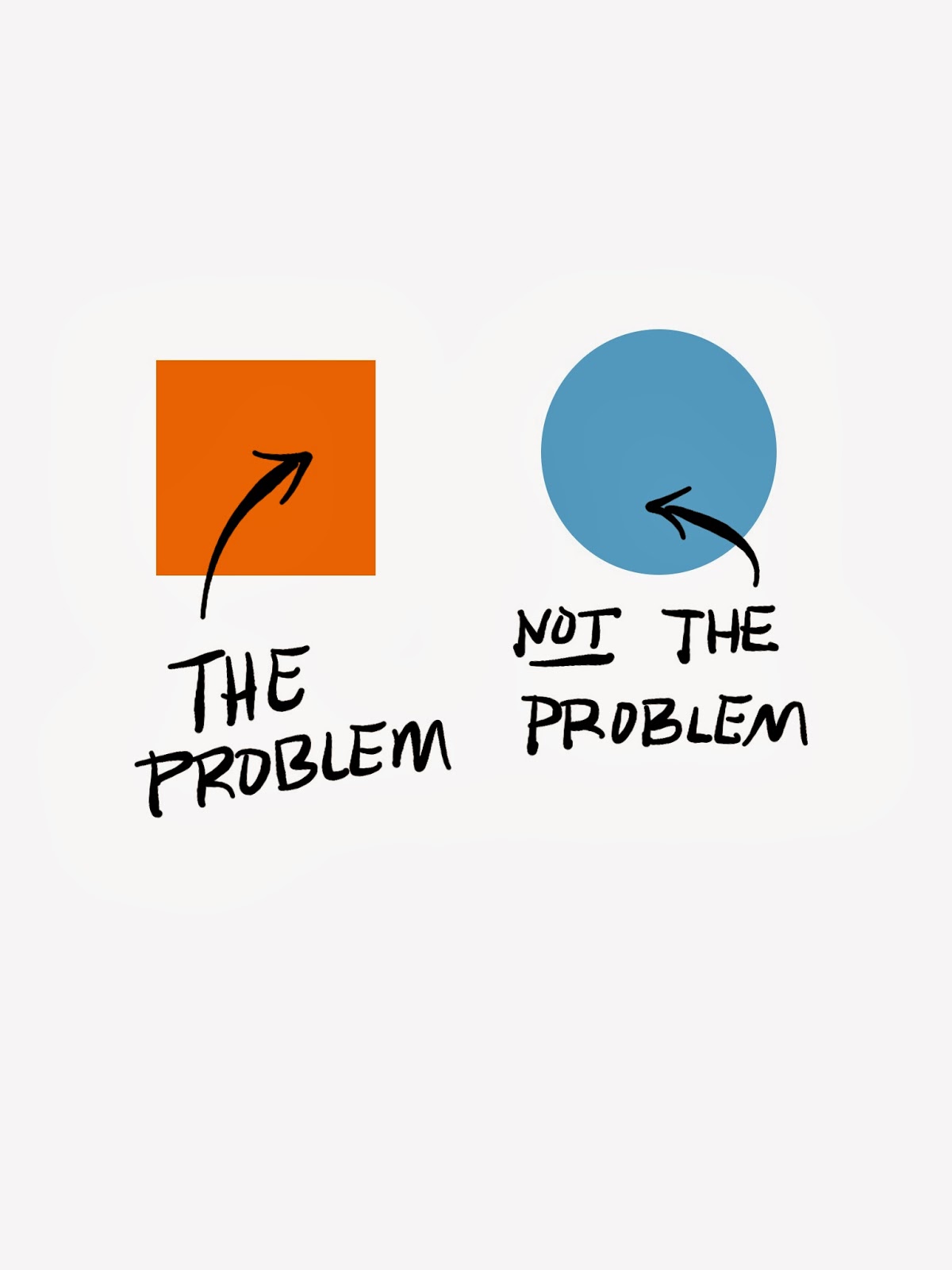
      “Are you trying to fix Susan or are you trying to fix the problem?” I asked.

      My colleague immediately recognized the emotional process at play. He realized that his reactivity was causing him to overfocus on Susan, and that he was triangling me into the situation by hinting that, as her supervisor, I needed to “fix” Susan. With that insight, we were able to shift the conversation from Susan to identifying what the problem was that needed to be fixed, in this case, clarifying a procedural matter between two offices.

      Reactivity often manifests itself in anxious behaviors: an overfocus on personalities, a misdirection of an issue, projection, triangling someone into the unresolved issues between two persons, scapegoating, etc. Because I was able to regulate my own anxiety in the midst of the meeting, I was able to ask myself “What’s really going on here? What’s the issue?” I was able to help my colleague  re-frame the problem. He was also able to get in touch with his own reactivity and realized how it was manifesting itself in triangling me into the matter by asking me to take responsibility for another person’s behavior and asking me to  “fix” that person.

      If I had been unfocused that day, things may have gone differently. I may have gotten caught up in the anxiety and reactivity, accepted the invitation to enter the triangle, made Susan the IP (Identified Patient), and my colleague and I could have launched into a futile project of trying to “fix Susan.” Furthermore, the real problem needing attention would have gone unresolved, which would serve only to increase the frustration and anxiety.

      When faced with reactivity it is helpful to monitor one’s anxiety and cerebrate rather than ventilate by asking oneself questions of discernment:

      • What is going on here, really?
      • Can I identify the triangle?
      • Do I need to accept the invitation into a triangle?
      • Am I responsible for alleviating another person’s frustration, discomfort, or anxiety?
      • Am I being asked to take responsibility for someone else’s behavior?
      • Do we want to try to fix a person or fix a problem?

      Israel Galindo is Associate Dean for Lifelong Learning at the Columbia Theological Seminary. Formerly, he was Dean at the Baptist Theological Seminary at Richmond. He is the author of the bestseller, The Hidden Lives of Congregations (Alban), Perspectives on Congregational Ministry (Educational Consultants), and A Family Genogram Workbook (Educational Consultants), with Elaine Boomer and Don Reagan. Galindo contributes to the Wabash Center's blog for theological school deans.

      Thursday, February 20, 2014

      Six responses of well-differentiated leaders

      Functioning at a high level of differentiation is the golden fleece for most congregational leaders who are students of BFST. Especially in times of acute systemic anxiety and symptomatic reactivity, effective leaders will work on focusing on the repertoire that will help them navigate the storm. In no particular order, here’s a six-action repertoire differentiated leaders tend to follow:


      1. Monitoring their own internal emotional process. Differentiated leaders are self-aware of the experience of their feelings, of how anxiety is being processed physically and emotionally, and awareness of the role family of origin dynamics are coming into play in the situation.
      2. Observing their functioning. Differentiated leaders are centered, clear, and responsive (emotionally present). They know the cues for when reactivity patterns start kicking in.  For example, overfunctioning or underfunctioning at work and at home, obsessing over issues, fantasizing, or distancing.  
      3. Regulating their anxiety. If reactivity patterns begin to manifest (e.g., psychosomatic symptomology), differentiated leaders work on regulating the experience of anxiety and moderate reactivity patterns.
      4. Avoiding reactivity. No matter how much they want to, differentiated leaders don’t call that acting out deacon a jerk or tender their resignation letter when frustrated.
      5. Getting clarity about their guiding principles and values. Differentiated leaders recall and rehearse their values, goals, principles, and vision (“Remind me again, why did I take this job?”).
      6. Seeking out resources. Differentiated leaders are not afraid of asking for help. They avail themselves of their coach or therapist, a spiritual friend, or support group. They don't seek advice about what to do or how to think, but use these resources to navigate through the emotional process in the midst of crises, acute anxiety, or reactivity. 


      It may help to write down “The Repertoire” and keep it in your wallet or tape it to your desk at the church office as a reminder for when acute anxiety bubbles up in the system. Acute anxiety will tend to focus on the person in the position of leadership (that’s you), so it will feel personal. The common reaction is to feel under attack or betrayed. When that happens, our most important resource goes out the window: our capacity to think through the problem and realistically assess what is going on in the system. When your brains shuts down in the midst of anxiety, pull out the list to reengage that frontal lobe. 

      Three Responses to Differentiation

      Assuming we’ve followed “The Repertoire” successfully and have managed to differentiate from out of our position of leadership in the system, we need to also take into consideration its aftermath. Experienced differentiated leaders know enough not to expect anyone to say “Thank you!” But there are three other predictable responses to a leader’s act of self-differentiation in the midst of an anxious system:

      1. Those who have the capacity will be able to self-regulate and also begin to self-differentiate. That deacon you wanted to call a jerk may now be saying, “Wow, I don’t know what happened to me. I got caught up in something and went crazy for a moment there.” These people are now resources for you and the system.
      2. A second group of persons will tend to fuse with you. A self-differentiated leader is “attractive,” even to those who lack a capacity for self-definition. Fusion can be seductive. It feels great to have a room full of people nod at your every word and eagerly agree with your every opinion. However, this group of people are not a resource to the system—the next loudest voice can just as easily redirect their passions.
      3. The third group of persons will be the ones who will withdraw or cut off from you. Clarity about one’s stance will feel like a line drawn on the sand to some folks. Self-definition demands a response and responsibility on the part of others. For those who lack resilience in thinking, or who are too insecure or too rigid in their beliefs, cutting off may be their only repertoire for dealing with challenge.


      Israel Galindo is Associate Dean for Lifelong Learning at the Columbia Theological Seminary. Formerly, he was Dean at the Baptist Theological Seminary at Richmond. He is the author of the bestseller, The Hidden Lives of Congregations (Alban), Perspectives on Congregational Ministry (Educational Consultants), and A Family Genogram Workbook (Educational Consultants), with Elaine Boomer and Don Reagan. Galindo contributes to the Wabash Center's blog for theological school deans.

      Monday, February 17, 2014

      Don't do these 10 things when dealing with reactivity

      All leaders will deal with reactivity at one point or another. It can be caused by a proposed change from the leader, it may be the result of direct and necessary action taken by the leader, or, it can come out of the blue. Leaders of necessity will have to deal with reactivity, but here are ten things NOT to do when reactivity makes its appearance:


      1. Confront it head on. Taking on reactivity head on rarely is an effective tactic. For one thing we will find ourselves addressing the reactivity rather than its cause. A frontal assault on reactivity is merely reactivity to reactivity. 
      2. Maintain an unreasonable faith in reasonableness. Persons caught in the grips reactivity are immune to data, or reasonableness. They are operating out of perceived threat, so their instincts have taken over the rational part of their brain. Allow time for the feeling of threat to pass before attempting a meeting of minds. There will be those who refuse to be reasonable for a number of reasons. The rules are different when dealing with those who refuse to reason. 
      3. Question or ascribe motive to poor behavior. Because reactivity is a product of by-passing cognition it's not helpful to question people's motives. They are, literally, not in their right mind. Realize that people in acting out their reactivity are not at their best and are not acting out of principled thinking. Most likely, persons caught in the grip of reactivity don't know why they are acting the way they are.
      4. Take it personally. Ninety-eight percent of the time, the reactivity that comes your way is not about you, even when it feels like it. Occupying the leader position means you're the point person for reactivity, it comes with the job. Some reactivity will be projection of other people's issues, perceptions, or unresolved conflicts. Some will come your way just because it's convenient to dump it on your desk. Some will come to your just because people are feeling powerless and need someone to "do something" about it. 
      5. Make it personal. Being on the receiving end of reactivity comes with the job. Often you'll be surprised at who vents frustration on you. Others will engage in a pattern of reactivity with you as the focus. Either way, focusing on the emotional process (people's functioning in the system) rather than focusing on the person, or personality, will help you get to the cause behind the reactivity. Personal attacks not withstanding, leaders do well not to take systemic problems worse by making it personal.  
      6. Neglect to assess your part of it. There are fives sides to every story, and three you'll never find out about. There will be occasions when the reactivity (and accusations) leveled at you will, to some degree, actually be "about you." Our tendency will be to deny culpability, deflect blame, made excuses, avoid the discomfort of the situation, or simply convince ourselves we are not part of the problem. Mature and effective leaders have capacity to self-assess honestly their roles in systemic problems, and they are able to sincerely apologize and work at doing better. 
      7. Forget to breath. When faced with reactivity we experience threat, and the biological response to it (fight or flight). Give your brain the oxygen it needs to think and reason--it's your most important resource in the midst of reactivity. So, breathe! 
      8. Neglect to step back. Whether physically or emotionally, taking a step back from reactivity provides perspective. Taking a step back physically from a person engaged in reactivity helps remove a sense of psychological threat. Thinking to oneself, "Will this matter six months from now," can provide emotional distance and offer perspective to the existentially painful moment. 
      9. Let your feelings rule over your principles. Informed values and principles are the two resources that provide correctives in the midst of reactivity. What values guide your relationship with persons--in whatever circumstance? What is your guiding principle when dealing with reactivity? 
      10. Forget your place. You are the leader in the system, and you can't forget that. One of the burdens of leadership is that those in leadership do not have the luxury of giving in to the baser emotions. Getting angry, feeling outraged, nurturing feelings of  victim-hood, holding a grudge, and lashing out may be emotionally cathartic, but once a leader gives in to them he or she ceases to be the leader in the system. When others in the system are loosing control of their emotions, that's the time a system needs its leader to be the most centered, non-reactive, and principled person in the system. 

      Israel Galindo is Associate Dean for Lifelong Learning at the Columbia Theological Seminary. Formerly, he was Dean at the Baptist Theological Seminary at Richmond. He is the author of the bestseller, The Hidden Lives of Congregations (Alban), Perspectives on Congregational Ministry (Educational Consultants), and A Family Genogram Workbook (Educational Consultants), with Elaine Boomer and Don Reagan. Galindo contributes to the Wabash Center's blog for theological school deans.